
Author: Saroj Ranjitkar, March 2024
Chhabdi Barahi temple is located at 7 km east of hilly forest of Damauli, Tanhun district, Gandaki Province of Nepal (Western Nepal). The temple is dedicated to the Fish Headed Goddess, a deity known for over two hundred years. Legend has it that before the temple’s existence, locals would fish at this site. One day, a fisherman’s arrow accidentally struck a rock, causing blood to mysteriously appear. This event prompted the cessation of fishing activities at the site. Instead, a small shrine was erected, eventually evolving into the renowned Chhabdi Barahi temple we know today.
The worshipping time is set from 8:30 AM to 3:30 PM. It is believed that if worshippers come and pray in this temple, their sins will be washed away. The priest of this temple is the indigenous Magar group who performs all the religious offerings on behalf of worshippers. The starting priest was Jahar Singh Ale Magar [1743 May 19 Sunday (9th Jestha 1800 BS)].
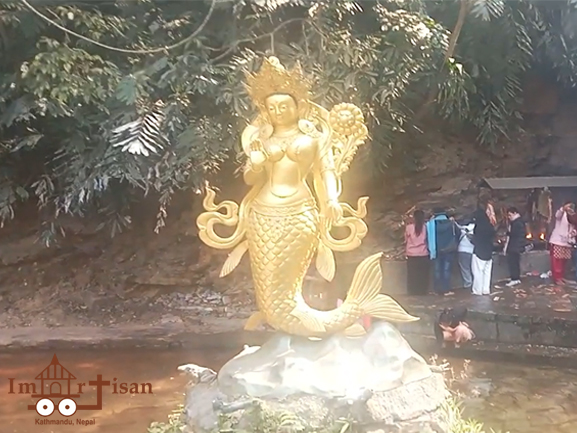
Near Chhabdi Barahi Temple there is a river named Chhabdi River with a small wooden bridge over the river. There is a Chhabdi faat a wide-open space of land without cultivation and a pond near Chhabdi Barahi temple. There is a small temple of Bhimsen where the sacrifice of five different animals and birds (Panchabali) takes place in Aswin (September-October). Late King Mahendra renovated the temple in the 1958 AD (2015 BS). Animal offerings or sacrifices are a common practice in this temple, performed to appease the Chhabdi (Fish-headed) goddess. Both Hindus and Buddhists worship this deity. Hindu devotees often make blood sacrifices to seek blessings from her. However, no animal sacrifice takes place during Aunsi (start of the new moon), Ekadashi, and the month of Shrawan (July-August) in Chhabdi Barahi Temple. There are plenty of shops around the temple where you can have a meal and give a try for a local taste after your worship is over.
Unveiling the Origin: The Story Behind Chhabdi Barahi Temple
Centuries ago, a fisherman cast his net into the waters, unaware of the extraordinary catch he was about to make. Among the fish ensnared in his net was one that, according to legend, drank the sacred sperm of Lord Shiva. Curiosity piqued, the fisherman carefully examined his catch and made a startling discovery – within the belly of the fish, a living girl child lay nestled.
Moved by compassion and viewing the child as a divine blessing, the childless fisherman took her under his care, adopting her as his own. As the years passed, the child flourished under the fisherman’s care, growing into a strong and capable girl. Grateful for the fisherman’s kindness, she joined him in his daily endeavors, assisting him in rowing the boat and tending to their livelihood on the water.
One day, as the girl assisted the revered sage Parashar in crossing the river by skillfully rowing the boat, her beauty caught his eye, leaving him spellbound. Moved by desire, sage Parashar expressed his wish to be intimate with her. Surprised by the proposal and citing her youth and the impossibility of such an act in broad daylight, the girl hesitated. Undeterred, Parashar assured her, invoking his powers to shroud the day in a dense fog, transforming it into a semblance of night. In this veiled setting, they shared a moment of intimacy, resulting in the girl becoming pregnant. From her womb, the illustrious sage Ved Vyasa was born. Vyasa went on to become renowned as the compiler of the four Vedas, the author of the Mahabharata, and the Srimad Bhagavatam. He also held the esteemed position of being the biological great-grandfather of the Pandavas and Kauravas, central figures in the epic tale of the Mahabharata.
Deeply troubled by her unpleasant and embarrassing situation of becoming a mother at such a young age, the girl confided in her son, Ved Vyasa, expressing her fears of tarnishing her reputation. In response, Ved Vyasa reassured her to take her to the eastern lands and then he collected and filled the pond with the holy water from 103 shrines. Centuries later, as the age of Kaliyug dawned upon humanity, the devotion and reverence towards these sacred waters manifested in the form of worship at the Chhabdi Barahi temple.

Спасибо за ваше сообщение. Мы ценим ваш объяснение и готовы для вас посодействовать. Если у вас есть какие-либо дополнительные вопросы или нужна дополнительная информация, не стесняйтесь спрашивать. Совместно мы сделаем наш форум еще лучше!
https://stopviolenta.md/biblioteca/legislatie/legislatie-naional/35-codul-de-procedur-penal.html
You’re welcome.
Regards
Saroj Ranjitkar
Head-Marketing
imartisan.org
977-1-9841743992