
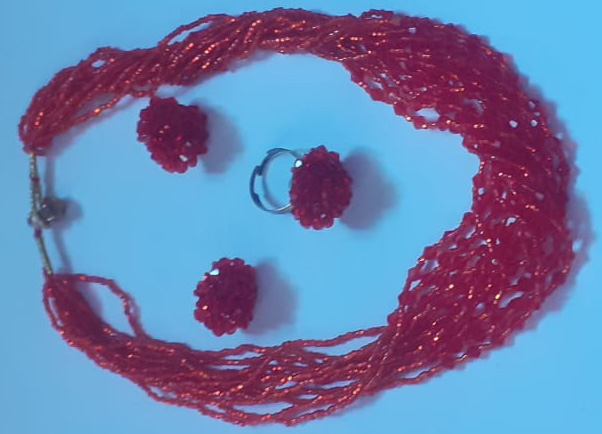
In the eastern society, Red symbolizes prosperity, good fortune, worn by brides and the symbol of joy. It is the color of purity, fertility, love and beauty. Red is generally taken to be the color of life, of the glowing sun and of passion. Married women in Hindu society, therefore, are encouraged to wear dresses of red colors or other hues close to the color. They wear bindis (artificial tika worn on forehead by females), vermillion mark (a dash of red powder put on by married Hindu women by partitioning the hair on two sides from the center of the forehead), tilharies (traditional necklace specially made out of beads) and the bangles all in red colors.
Red is also the color of desire. The sexual urge, the impulses and general vigor of individuals are attributed to the color red. It is for this reason that during the time when Hindu orthodoxy prevailed, widows, particularly females, were refrained from wearing clothes in red color, as they were not allowed to remarry. The Hindu philosophy regards widowhood as a social misfortune and imposes for the widows many conducts related to dress, color, behavior and others. If a Hindu woman loses her husband, she has to wear a white sari for a whole year. She also has to give up all signs of marriage like glass beads around her neck (Potey in Nepali word), Bangles and vermillion mark on her forehead (Sindoor). After one year, she is allowed to wear clothes with colors other than red or shades of red or other bright colors and she still can’t wear glass beads, glass bangles and vermillion mark. They are also forbidden from remarrying. It is believed if a widow marries another man; her deceased husband’s soul goes to hell. But if this case is added to men, he is allowed to remarry again and does not compulsion to live in mourn life of her wife. This sounds ridiculous but that is what the widows are led to believe.
In ancient times, there used to be ‘Sati’ practice (burn with her husband’s pyre or any of his remaining) in which if a married man died, the widow was coerced to join her husband in his funeral pyre. This was the cruel customs followed by Hindu religion in Nepalese society. In 1924 A.D. Prime Minister Chandra Shamsher abolished Sati System from Nepal. Rules regarding abolishing Sati issued on 1974 A.D. Only after then women were allowed to live though the red costume is forbidden to wear.
The majority of Nepali women (both educated and non-educated) are strongly attached as the housewife and helper of the husband rather than his equal partner. The wife on her part performs traditionally identical duties, compulsions and responsibilities. She is obliged to be appropriated and well-mannered to her husband in her wedding promise and move ahead with her life of a just right pativrata(devoted wife).
The traditional patriarchal thought requires a wife to be a propitious for her husband. The long-established religious principles (Dharma Shastras) prescribed in Manu-Smriti has mentioned that among Hindus the women are accountable for ensuring the social, physical and spiritual happiness of males, especially in their role as wives. They can satisfy this duty through dedicating themselves to the life of their husbands. Her devotion and fidelity to her husband is thought important to prolong his life too. At the same time, she is also regarded as a cause to bring him death and misfortunes. His death further afflicts many other types of problems in her life including change of her socio-cultural identity and loss of freedom in many issues. In other words, a husband’s death results in a number of social and cultural problems in the life f his widow. She retains only a limited or restricted level of freedom to remarry, own property, and take advantage of social and economic opportunities provided for male by society.
In the context of Nepal, the color Red symbolizes color of purity, fertility, love, beauty, wealth, opulence and power; used in wedding ceremonies, a sigh of a married woman; also color of fear and fire (Cultural meaning of Color and Color Symbolism). Among the symbols mentioned, of the color Red, it is clearly written about the indicator of a married women or the representing color of one with husband. During the wedding of Hindu Brahmin/Chhetri daughter, one can observe a bride wearing red saree, bangles, red vermilion mark on her forehead. Based on all the mentioned cultural code a woman gets power, strength to earn respect in the society. In the Brahmin/Chhetri society it is observed that, majority of women lives a dignified life with her husband along with her in laws. There are no restrictions for her to fulfill the basic necessities. In this case, one can say that a woman is known around the society if only she is wife, daughter or sister of male counterparts. This can be related to the statement by the French Feminist, Simone de Beauvoir, on her book “The Second Sex”. Beauvoir has stated that humanity is male and man defines woman not herself but as relative to him. The wearing of red color by a mature woman indicates about having male partner and the wearing of such color safeguards her.
Once the husband dies, the color choice of the same women gets completely restricted. The patriarchal society among the Hindu caste is so deeply rooted that, if a man becomes widower there are no such restriction either in a color choice, or fulfilling any other basic necessities. Here, wearing pattern defines the marital status of women. It projects either she is widowed or with husband. Once the husband dies, his wife is abandoned by his family members and in the near future she will be the pre for financial crisis, legal problems, social exclusion, depression or sometimes suicide. In Hindu culture, women with light colors other than red are in risk of harassments, torture and even raped. Widows are convinced that they have they have sinned in past life; otherwise, they wouldn’t have been punished by god with the terrible state of widowhood. The widow is then expected to spend most of her time in prayers to god trying to atone her past sins.
Color is Birth Right and single women (widow) must have the right to wear a color of their own choice, instead of white – which had been imposed for widows. Imartisan is advocating in breaking this negative norms and practices. Initially it was a great challenge to revolt against the religious and cultural practices. Imartisan provides appropriate training and works which makes their confidence higher to gain social status and dignity.
If you took time to read this, thank you very much. (www.imartisan.org) Email: marketing@imartisan.org